
Showing posts with label drawing. Show all posts
Showing posts with label drawing. Show all posts
Friday, January 29, 2016
What do I need to buy if I want to start learning how to draw?
Here is my answer to What do I need to buy if I want to start learning how to draw?
 Get a sketchbook, a pencil and practice all the time. That said I like to use a 2mm lead holder with 4B lead. Staetdler makes one with a point sharpener in the end. I like it because I can carry it with me and I don't have to worry about sharpening. It even works out to be less expensive if you compare the cost of drawing pencils and how much gets wasted in sharpening! A kneaded eraser is pretty great to have. I use the black hard bound sketchbooks 9x12 or sometimes 6x8. You don't need anything special but getting new toys certainly can be inspiring and keep you going.


Wednesday, January 27, 2016
What are rules and tips for foreshortening an object?
Here is an answer to a question about foreshortening.
You can figure out foreshortening by using the rules of perspective. It would be too complex to describe the rules of perspective here, but in a nutshell...
The basic idea of linear perspective is that objects in space look smaller the farther away they get from the viewer. If you learn to draw a box using linear perspective you will be able to draw boxes that appear to be in a three dimensional space. Anything can be put into a box. The parts of a thing can be broken up into smaller boxes. Even figures and the parts of a figure can be placed in boxes. The more you can master the rules of perspective the easier it will be for you to draw things in a 3D space. You will understand how and why things look foreshortened.
You can figure out foreshortening by using the rules of perspective. It would be too complex to describe the rules of perspective here, but in a nutshell...

The basic idea of linear perspective is that objects in space look smaller the farther away they get from the viewer. If you learn to draw a box using linear perspective you will be able to draw boxes that appear to be in a three dimensional space. Anything can be put into a box. The parts of a thing can be broken up into smaller boxes. Even figures and the parts of a figure can be placed in boxes. The more you can master the rules of perspective the easier it will be for you to draw things in a 3D space. You will understand how and why things look foreshortened.
Saturday, July 25, 2015
Sketchbook Studies
Jean commented on the method of doing thumbnail studies. I bucked this type of preliminary work, wanting to use a more improvisational approach in my work when I was younger. I worked intuitively and reacted to what was happening in the moment. When I began a series of realistic observational still life paintings 14 years ago I started to see the advantage to doing preparatory studies. When I started following the steps. (I actually created my own method somewhat based on classical techniques.) I was having less failed paintings and I was much faster. I could also expand and work in any size I wanted.
In researching classical methods and found that this preliminary work is extremely important. You can go to visit James Gurney's blog to start learning about adopting the old techniques. He is very generous with his knowledge. There is a huge explosion of information on classical painting techniques so you will have no trouble finding information. Other resources you might like are illustrators who work using classical methods such as Donato Giancola and Dan Dos Santos also there are atielier trained artists like Stan Prokopenko.
I have always been interested in intuition and improvisation. I have developed a synthesized technique for myself. I create dozens if not hundreds of thumbnail compositional studies. These play a different role than they do to classical or imaginative realism. I don't want to create a roadmap or plan for a painting. I want to focus on intuition and improvisation while I am painting even when it comes to composition elements. These studies serve as a method of developing the abstract visual language and mark making language. I find it extremely important in my work.
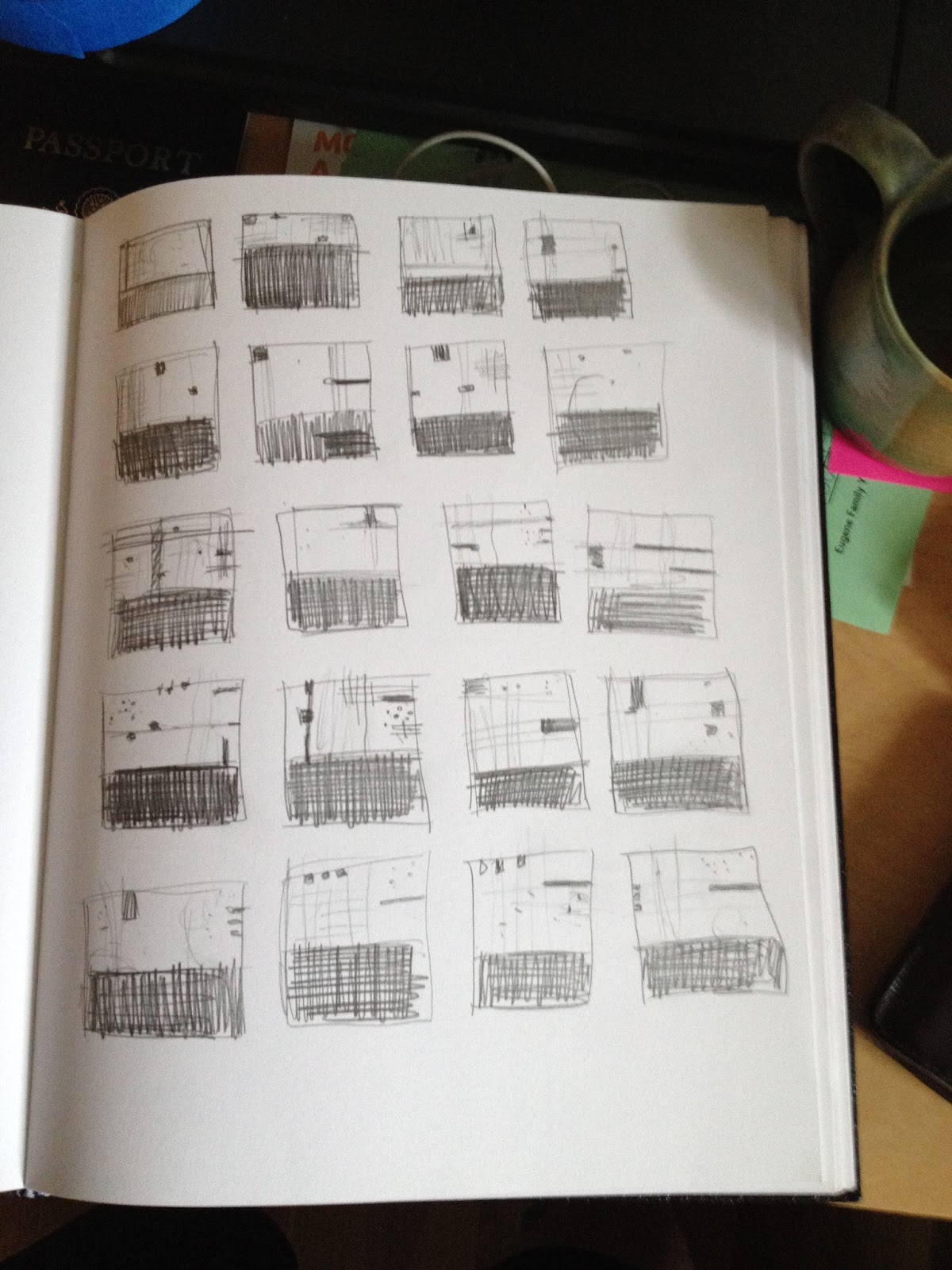 |
| Sketchbook Page |
 |
| Magma Chamber on the easel |
Monday, July 20, 2015
Idea Mining
To get ideas I just start doing these little scribbles. I am starting to look for something to develop. I am searching for the thing that will light the fire. The idea is the most important thing. I know what to do when the idea comes.

Subscribe to:
Posts (Atom)